Una cuchara digital llega a una cocina caótica. Su misión: traer orden exacto. El problema: sus dueños son un desastre. Historia de precision y caos culinario. 🥄⚖️ #RelatoSarcástico #CaosEnLaCocina Ah, sí. Permítanme presentarles a la protagonista de nuestro relato moderno: La Precisión Hecha ABS . No era una cuchara cualquiera, oh no. Era una Cuchara Medidora Digital de Cabezal Desmontable , capaz de pesar hasta 800 gloriosos gramos de... lo que fuera. Llegó a su nuevo hogar en un empaque ridículamente ergonómico, prometiendo el fin de las galletas aguadas y el café desabrido . Su pantallita digital parpadeaba con la inocente arrogancia de quien aún no conoce el frente de batalla. Su primera misión fue la "Operación Brownie Perfecto". La usuaria, una entusiasta del " un ojo de buen cubero ", la sacó con reverencia. La cuchara, en su modo gramos, emitía un pitido de satisfacción con cada 100g de chocolate. Todo era orden y luz LED. Hasta que... la usuarla deci...

Clothing retailers sell their shoppers more than jeans and sweaters.
Major apparel companies also sell credit, often with very high fees, like The Gap’s 21.7% starting interest rate, and US$27 to $37 late payment charge. In 2019, Macy’s store credit card revenue of $771 million accounted for more than half of Macy’s operating income.
As researchers studying retail clothing workers, we never expected to learn about credit cards. When we asked the workers about the worst part of their jobs, we expected to hear about low wages, inconsistent schedules and rude shoppers.
Those things matter, but many workers identified mandates to push credit card applications on customers as the worst part of their jobs. None of the retailers mentioned in this story responded to requests to explain their corporate policies on consumer store brand credit.
Ethical dilemma
Why do workers find this task so troubling?
Our research shows that they know – sometimes from personal experiences – how credit cards can ruin a person’s finances.
“The credit cards have a 25% interest rate, and people don’t always read that,” Elise, a woman who had worked at Target, explained. “They saw it as ‘something else I can use to pay later and not have to pay money now.’”
A Gap customer who buys $300 of clothing, and pays the minimum each month of about $25, will pay off that purchase in 14 months, and pay more than $40 in interest. If they miss just one payment, they will likely pay more than $75 in interest and fees.
Rachel has worked at American Eagle and pointed out how credit cards often hurt credit scores: “People, especially my age … don’t realize that. They’re 18 years old and a credit card sounds awesome.”
Gabe, another American Eagle employee, refers to his store’s credit card as “a Visa that has the American Eagle logo at an extremely high interest rate,” explaining that only “gullible” customers sign up.
Credit card debt can cause substantial problems. Many people have to take multiple jobs simply to manage their debt.
Getting behind on credit card bills often leads to higher interest rates and late fees – making it even more difficult to pay off the debt. Those who go into bankruptcy to discharge their credit debt may not be able to take out any loans to buy a car or a house for a decade or more.
Credit also has the potential to exacerbate inequality. Federal Reserve data on credit denials also shows that for people at the same income level, Black and Hispanic consumers are more likely to have their applications denied.
How it works
In about half of the 35 clothing retail stores we studied, cashiers are expected to prompt all customers to apply for a store credit card. Workers cannot refuse to sell credit cards when they are working shifts on registers.
During our research, we found that management keeps track of those sales by using electronic surveillance to identify exactly how many credit cards each worker sells during each shift. Management monitors how well individual workers and store locations sell credit through data from the cash register.
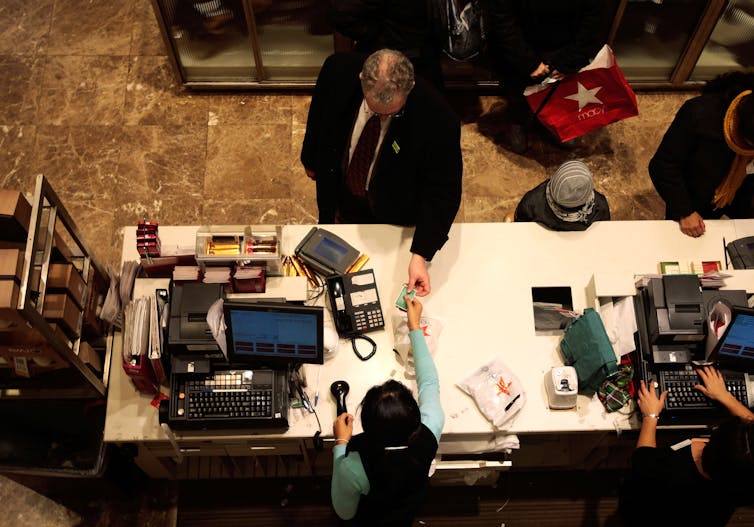
Tara, a shift lead at American Eagle, said she needed to sell 2.5 credit cards for every 10 transactions at the cash register.
Old Navy managers also expected cashiers like Danielle to sell two cards per shift. Special sales events intensify these goals. For example, Danielle was told to sell five to 10 credit cards during Black Friday shifts.
Our research found that those who perform above expectations – for example, selling five credit cards during a normal shift – may get a gift card, a bonus of $1-$5 or a pack of gum. Stella, a Macy’s worker, explained, “We get credit for people who don’t even get approved for the applications.”
Most of the workers that we interviewed said if they don’t sell enough credit cards they may find themselves off the work schedule and without a job.
Corporate credit push
Workers shared our surprise: Many didn’t expect clothing retailers to emphasize selling credit as much as selling clothes.
As Melissa, a sales associate at J.C. Penney, told us, “Surprisingly, our main focus is credit applications. They really drive that back at home. They want as many as possible.”
Retailers tout that the credit cards offer discounts on merchandise, are easier to qualify for than traditional credit cards and allow customers to build a credit history.
Yet managers rarely admit to workers that credit cards lead to profit. Nicole works at Nordstrom Rack and recalled her manager asking, “‘Do you know why we have a credit card?’ … I was just, like, ‘So you can make money on the interest?’ They were, like, ‘Well, a lot for brand awareness and to remind people if they have the card in their wallet they might come to our store.’”
While Nicole believed that the credit cards are aimed at increasing profits, her manager corrected her, emphasizing “brand awareness” instead. According to Nordstrom’s annual report, credit card revenues brought in $387 million of revenue in 2021 compared with $14.4 billion of apparel sales
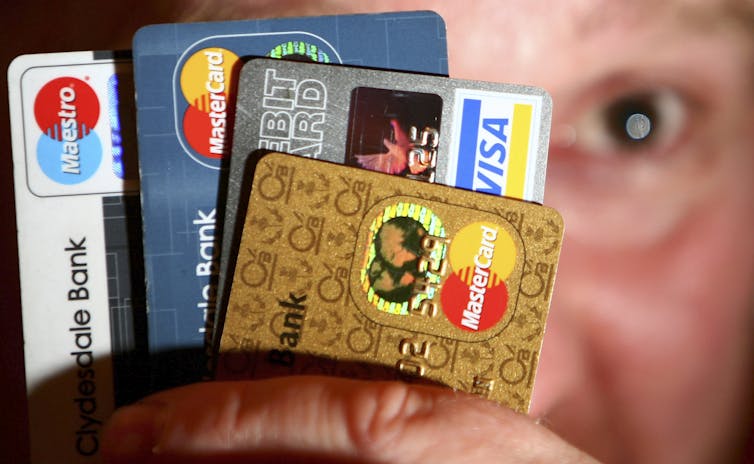
Many workers, like Carmen, a woman with almost two years of retail experience at Sears and Free People, finds it difficult to sell something that she believes can harm customers. In her view, credit cards “are the worst thing ever.” “It’s like trying to push something that you’re trying to make it seem like it’s something that’s so good,” she said. “But in the end, it’s not. It’s just another way to spend money.”
Workers realize, as did Grace, a T.J. Maxx worker, that financially “it makes sense but morally … it’s not what’s best for our customers.” She further explained, “If they want to buy our products, that’s their choice, but if we are going to charge them interest rates, that’s another thing. It just seriously pisses me off.”
Marty has worked at Target for 3½ years and similarly worried: “I just hear stories of … getting people who are on food stamps who sign up for these credit cards, which is going to hurt their credit, and they know they’re going to get denied … but (the managers) still, like, push it. And it’s just, like, was that ethical to do that?”
Acts of resistance
Some workers try to resist these mandates. Grace, the T.J. Maxx worker, recounted, “These women come in and they’re, like, ‘Well I’ve already been denied twice. Oh, I’ll just try again.’ And I’m, like, ‘No, don’t try again because that’s going to pull your credit down even further and that’s bad.’”
Corinne has worked more than five years at retailers including J.C. Penney and Forever 21. She also resisted pressure to sell credit, saying, “I preferred not to be on register … because I usually don’t ask people.” Corinne avoided the register rather than be disciplined for not asking customers to apply for credit cards.
Even Angela, who works at Old Navy and says she “rocks at selling credit cards,” emphasized, “It’s the one value of that store that I just don’t align with … the worst part of the job.”
Our research finds that retail workers, despite being in low-paid jobs with unpredictable hours, often see credit card sales as the worst part of their jobs. And that’s because they empathize with customers and want to help them – not lead them to financial ruin.
Joya Misra, Professor of Sociology & Public Policy, UMass Amherst and Kyla Walters, Assistant Professor of Sociology, Sonoma State University
This article is republished from The Conversation under a Creative Commons license. Read the original article.
Comments
Post a Comment